For twenty years, MT103 was how the world moved money. That era has ended
If you have ever sent an international wire, the confirmation you received almost certainly traced back to a message called an MT103. It was the workhorse of cross-border payments: a compact, tag-based instruction that told one bank to pay another, first standardised on the SWIFT network in the 1970s and refined for decades after. On 22 November 2025, after a long transition, SWIFT switched off the coexistence period that let the old format run alongside its replacement. For cross-border payments, the classic MT messages are now retired in favour of a richer standard called ISO 20022.
This is the biggest change to the plumbing of international payments in a generation, and most people sending money will never see it directly. But it changes what data travels with your payment, how quickly problems get resolved, and how the whole system will evolve from here. If you want a plain-language refresher on what does MT103 mean before we get into what replaced it, that explainer is a good starting point. This guide covers what actually changed, why it matters, and what you should do about it.
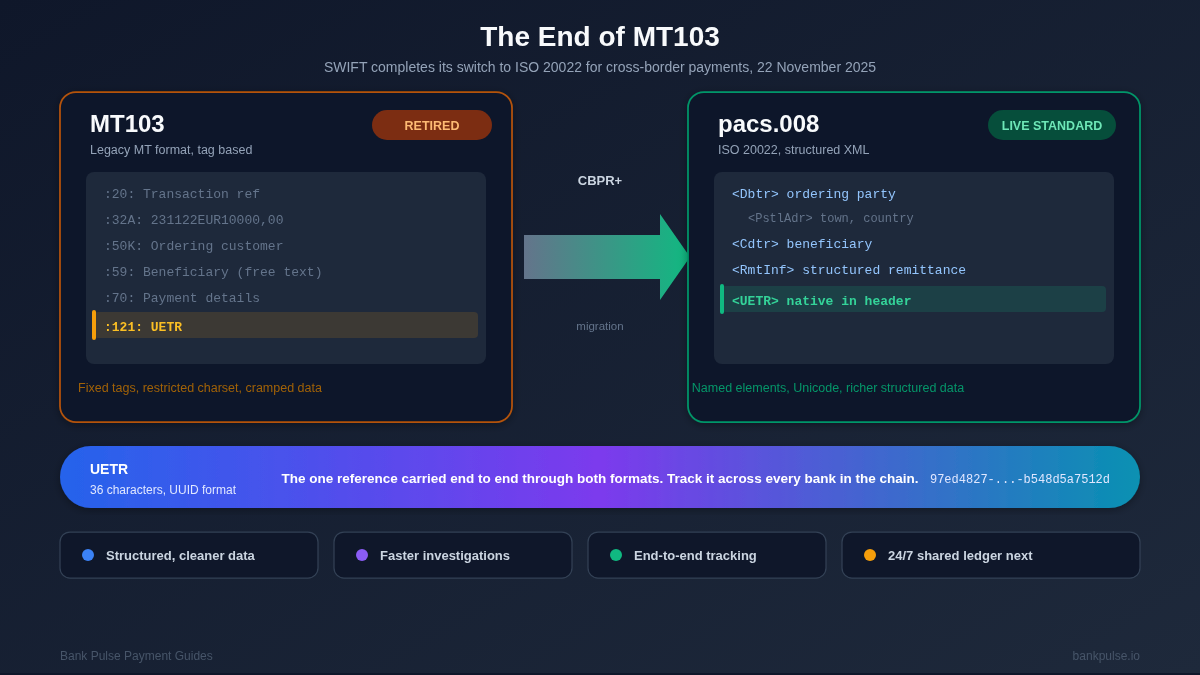
What actually changed in November 2025
SWIFT ran a three-year coexistence period, starting in March 2023, during which banks could send payment instructions in either the old MT format or the new ISO 20022 MX format. That window was always meant to close, and it did on 22 November 2025. From that date, the core cross-border payment and reporting messages must be exchanged as ISO 20022 under the market practice known as CBPR+, short for Cross-Border Payments and Reporting Plus.
In practical terms, two messages you may have heard of have been replaced:
- MT103, the single customer credit transfer, becomes pacs.008. This is the instruction behind a normal customer wire, the message that says pay this beneficiary this amount.
- MT202, the bank-to-bank transfer, becomes pacs.009. This is the message banks use to move funds between themselves, often to cover the customer payment above.
SWIFT has not left anyone stranded. A contingency service can still accept an MT instruction and translate it into ISO 20022 in flight, so a bank that is behind schedule is not cut off. That safety net comes at a price: from 1 January 2026, extra charges apply for both contingency processing and the in-flow translation service. The message from SWIFT is clear enough. Translation is a bridge, not a destination, and the meter is now running on it.
What ISO 20022 is, and why it took twenty years to arrive here
ISO 20022 is an international standard for financial messaging. Where an MT103 packs data into short numbered tags such as :20: for the reference and :59: for the beneficiary, ISO 20022 uses structured XML with named elements, so a field is labelled for exactly what it is. That sounds like a cosmetic difference. It is not.
The old format was built when bandwidth was scarce and every character counted. It squeezed names, addresses and payment details into a handful of free-text lines, which meant a lot of important information arrived as an unstructured blob that software could not reliably read. ISO 20022 breaks that blob into discrete, machine-readable fields: a separate element for a street, a town, a postcode, a country, a purpose code, a legal entity identifier. Richer, cleaner data flows end to end, which is exactly what compliance systems, fraud checks and reconciliation engines have been starving for.
That is also why the migration took so long and slipped more than once. Rewiring every core banking system, screening engine and reporting tool on the network at the same time is an enormous coordination problem, and regulators pushed the deadline rather than break the plumbing. The payoff is a payment message that finally carries structured data instead of a telegram from the 1970s.
MT103 and pacs.008 side by side
| Aspect | MT103 (legacy MT) | pacs.008 (ISO 20022) |
|---|---|---|
| Format | Tag-based text, fixed blocks | Structured XML, named elements |
| Fields | Numbered tags such as :20:, :50K:, :59: | Labelled elements such as Dbtr, Cdtr, RmtInf |
| Character set | Restricted SWIFT character set | Broad Unicode support |
| Addresses | Free text, a few lines | Structured: street, town, postcode, country |
| Remittance data | Short, often truncated | Rich and structured |
| Tracking | UETR added later, in field 121 | UETR native in the message header |
| Status for cross-border | Retired since 22 November 2025 | Mandatory under CBPR+ |
The UETR is the thread that survives the switch
Amid all the change, one thing did not just survive but became more central: the UETR, or Unique End-to-End Transaction Reference. It is the 36-character code, formatted as a UUID, that has uniquely identified every SWIFT payment since it became mandatory in November 2018. In an MT103 it lived in field 121, a bolt-on to an older design. In pacs.008 it sits natively in the message header, exactly where a modern standard expects a transaction identifier to be.
The UETR is what makes end-to-end tracking possible. As a payment hops from the sending bank through any correspondent banks to the beneficiary bank, each institution reports its status against the same UETR, so the payment can be followed the whole way rather than disappearing into a black box. SWIFT gpi, the tracking layer built on top of this, now moves the large majority of cross-border payments to the beneficiary bank within an hour, and the UETR is the reference that ties every status update together.
For anyone chasing a payment, this is the practical takeaway. Ask your bank for the UETR, or find it on your payment confirmation, and you can run a UETR lookup to see where the money is in the chain. We cover the mechanics in more depth in our guides to the UETR and why it changed international payments and tracking a payment step by step.
What the switch means for businesses and treasury teams
Most of the migration happened inside banks, but a few effects reach the businesses that send and receive payments.
- Structured addresses are now expected. Since November 2025 a payment must carry at least a town and country for the debtor and creditor in structured form. Fully unstructured addresses are being phased out entirely, and will be forbidden after November 2026. If your accounts payable system still stores counterparties as a single free-text address line, that is the thing to fix before the next deadline.
- Richer remittance data travels with the payment. Invoice numbers, purpose codes and structured references can now ride along in fields built for them, which means fewer payments that arrive without anyone knowing what they are for. Cleaner reconciliation is the quiet win here.
- Investigations resolve faster. Queries about a stuck or missing payment used to travel as free-text MT199 messages that a human had to read and interpret. They now use structured camt messages, so a bank can resolve many exceptions automatically and far more quickly than before.
- Late movers pay for the bridge. If your bank is still relying on the contingency translation service, it is now paying SWIFT extra to do so from January 2026, a cost that tends to find its way downstream. It is a fair question to ask your provider whether they are fully on ISO 20022 or still leaning on the crutch.
What comes next: SWIFT's shared ledger goes live
The MT retirement clears the way for what SWIFT wants to build next. On 9 July 2026, SWIFT announced that its new blockchain-based shared ledger is ready for initial use, with seventeen major banks from six continents, including HSBC, Citi, BNP Paribas, Standard Chartered, UBS and Wells Fargo, lined up to pilot live transactions. The ledger is designed to let banks move tokenised deposits around the clock, including overnight and at weekends, before final settlement runs through existing systems.
Built in around nine months with feedback from those institutions, it points at a future of always-on cross-border payments and, further out, programmable money. None of this replaces the messaging network you use today. It builds on the same rails, and the move to ISO 20022 is part of what makes richer, always-on payments feasible in the first place. The structured data standard is the foundation, and the shared ledger is the first floor built on top of it.
Frequently asked questions
Is MT103 gone completely?
For cross-border payments over SWIFT, yes, the MT103 was retired when the coexistence period ended on 22 November 2025. A contingency service can still translate an MT instruction into ISO 20022 for banks that are behind, but it carries extra charges from January 2026 and is meant as a temporary bridge, not a permanent option. Some domestic systems continue to use MT-style formats on their own timelines.
What replaced MT103?
The pacs.008 message under ISO 20022, following the CBPR+ market practice for cross-border payments. It carries the same core instruction, pay this beneficiary this amount, but as structured XML with far richer, cleaner data than the old tag-based format allowed.
Do I still get a UETR after the migration?
Yes, and it matters more than ever. The UETR is now native to the ISO 20022 message header rather than an add-on field, and it remains the reference you use to track a payment end to end across every bank in the chain.
Will my international payments be affected?
The change is mostly invisible from the customer side, but there are two practical effects. Your bank may ask for more structured address details for beneficiaries, and payments should arrive with cleaner reference data, which makes reconciliation and investigations faster.
What is CBPR+?
CBPR+, or Cross-Border Payments and Reporting Plus, is the set of agreed usage guidelines that defines how ISO 20022 messages are used specifically for cross-border payments over SWIFT. It ensures every bank fills in the new messages the same way, so the structured data stays consistent across the network.
The bottom line
The retirement of MT103 is the end of a format that quietly moved trillions across borders for decades, and the start of a payment system that finally carries structured, machine-readable data from sender to beneficiary. For most people the switch is invisible, but the benefits are real: cleaner data, faster investigations, and a foundation for the always-on, tokenised payments SWIFT is now piloting. The one habit worth keeping through all of it is simple. Hold on to your UETR, because whatever the message format underneath, it is still the reference that lets you follow your money. To look up a bank before you send, Bank Pulse has the SWIFT and BIC details on every institution, and to track a live payment, a UETR lookup shows you exactly where it is.