ChatGPT and the Claude app answer questions. They do not keep working
Most people meet AI through a chat window. ChatGPT, Gemini and the Claude app are very good at it: you ask, they answer, and over the last two years they have picked up real tools, from web search and a code sandbox to file uploads, connectors for Gmail and Google Drive and, in some apps, a simple scheduled prompt.
The shape underneath has not changed, though. The work happens inside the vendor's sandbox, with the vendor's list of tools, for as long as the conversation is open. A chat assistant cannot install the one library your supplier's spreadsheet needs, cannot keep a script of its own running on a machine of its own, and is not sitting there at 2 a.m. when an invoice lands in your inbox. Close the tab and the job is over. For a question that is fine. For work that never stops, such as mail that arrives overnight, a report due at six or a customer who writes in Telegram on a Sunday, it is the wrong tool.
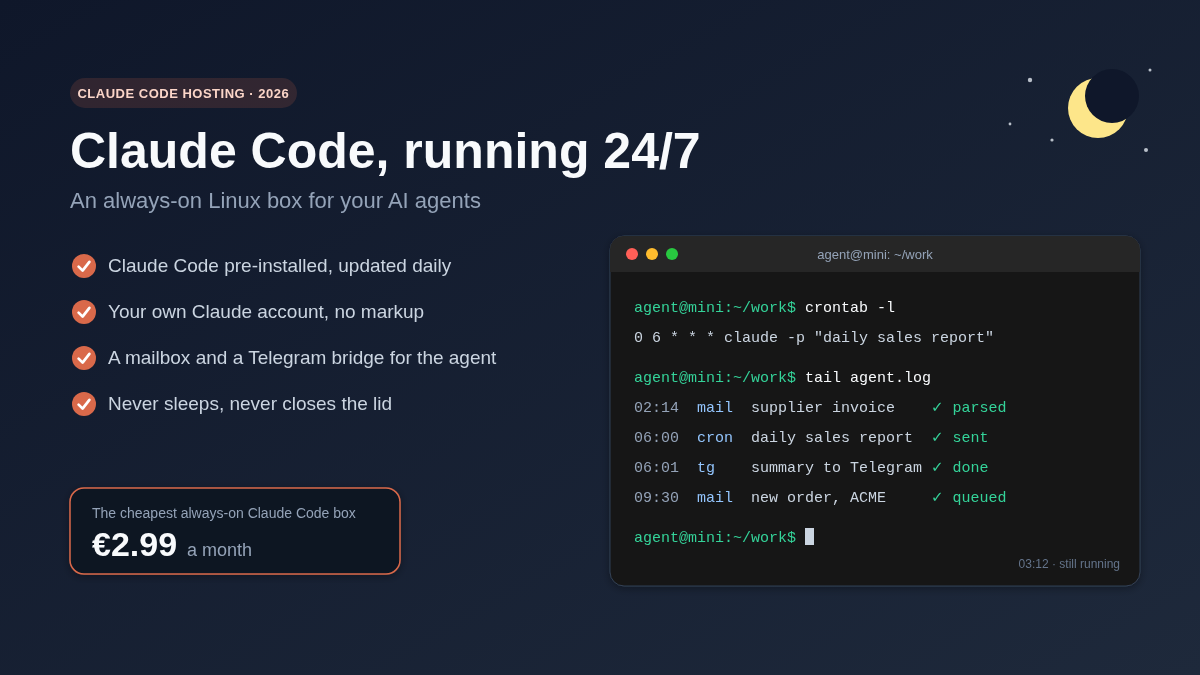
That gap is what Claude Code fills, and it is why more and more people now run it on a small Linux server that stays on around the clock. This guide explains why, what to look for in that server, and how the machines sold for the job compare on price, including our sister service combobulating, which sells the cheapest VPS Linux box for Claude Code in the comparison below.
The short answer. To run Claude Code 24/7, put it on an always-on Linux server instead of your laptop, sign it in to your own Claude Pro or Max plan, and let a schedule, a mailbox or a Telegram bot hand it work. You can build that yourself on any VPS if you know Linux. If you would rather not, the combobulating Mini is the cheapest always-on machine sold for the purpose: 2.99 EUR a month, with Claude Code, a mailbox for the agent and a Telegram bridge already installed (prices checked on 22 September 2026).
What Claude Code does that a chat window cannot
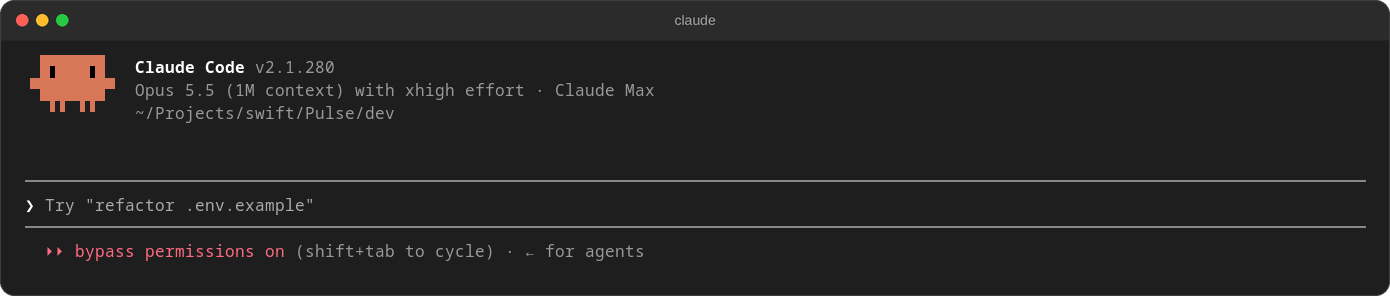
Claude Code is Anthropic's AI agent that runs in a terminal. It uses the same Claude models as the chat app, but instead of replying in a chat bubble it works on a real computer. It reads and writes files, runs shell commands, installs packages, calls APIs, runs the scripts it writes and checks what they print, and keeps going through a multi-step job until the job is done.
Developers adopted it first, but nothing about it is limited to code. It is just as happy turning forty PDF invoices into one spreadsheet, reconciling a bank export against your accounts or chasing the three suppliers who have not confirmed a delivery date.
Three things make it suitable for work that runs without you:
- It runs headless.
claude -p "..."runs one job from start to finish with nobody at the keyboard and then exits, so cron, a script or an incoming email can start it. - It remembers the setup. A
CLAUDE.mdfile in the working folder tells every run what the machine is, where things live and what the rules are, so a job at 6 a.m. starts with the same context you gave it at noon. - It works on your own subscription. Claude Code signs in to a Claude Pro, Max, Team or Enterprise plan, or to an API account. The thinking is billed by Anthropic at the price you already pay, not marked up by whoever hosts the machine. The free Claude plan does not include Claude Code.
Why 24/7 means a separate Linux machine
You can run Claude Code on your laptop, and most people start there. The trouble begins when you want it to work while you do not.
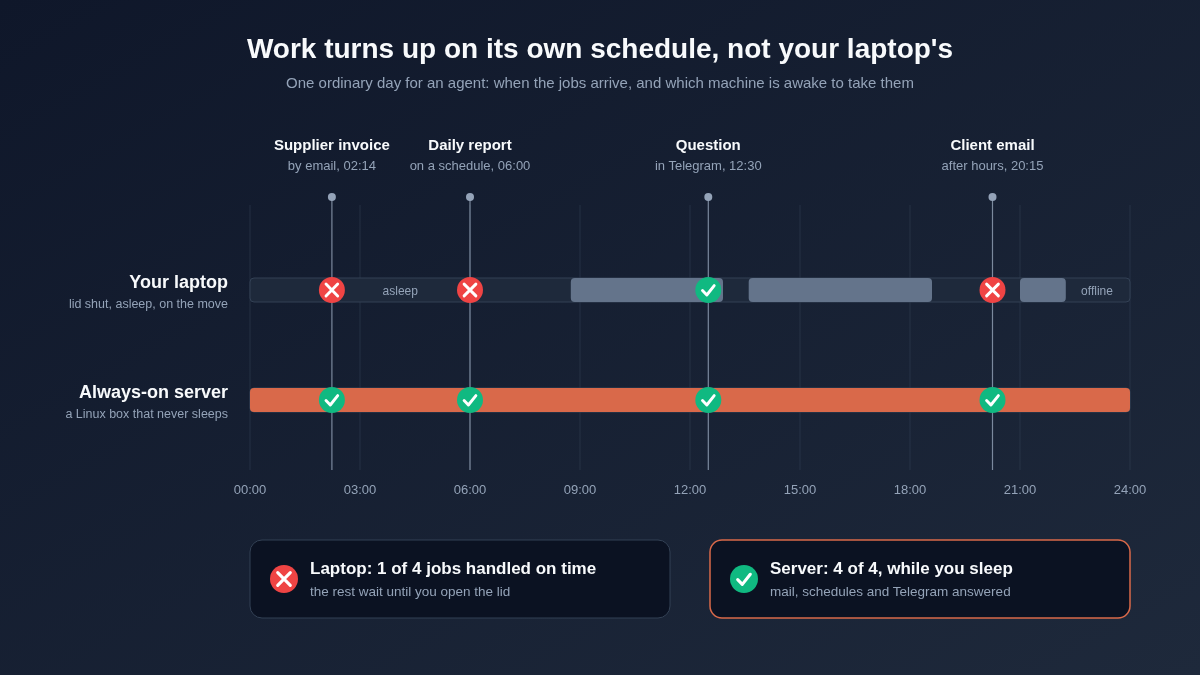
- Laptops sleep. Close the lid, lose Wi-Fi on a train, let the battery run down or install an update overnight, and every job scheduled for that window quietly does not happen.
- An agent should not live next to your life. An agent that is allowed to act without asking should run on a machine that holds nothing but the work. Your laptop holds your password manager, your browser sessions, your SSH keys and your family photos. On a separate box, a bad command costs you an afternoon, not your laptop.
- Mail, webhooks and bots need a fixed address. A mailbox the agent reads, a Telegram bot it answers or a webhook from your online shop all need a machine that is in the same place and switched on all the time.
Linux is the natural choice for that machine. Claude Code runs natively on it (Ubuntu 20.04 or later, Debian 10 or later), the cheapest servers in every cloud are Linux, and the tools an unattended agent leans on are standard there: cron for schedules, systemd to restart things that stop, tmux to keep a session alive after you disconnect. You never need a desktop. You reach the box through a terminal, in the browser or over SSH.
What to look for in a Claude Code server
Almost any VPS can run Claude Code. The differences that matter show up after a few weeks, not on the first day:
- It really is always on. Some free and cheap plans sleep, stop or reclaim a machine when it looks idle, and an agent waiting for mail looks idle most of the time. Read the small print for words like "sleep", "idle" and "reclaim".
- Enough memory for what the agent does. Anthropic's own requirement is 4 GB or more. In practice an agent that works with mail, files, schedules and APIs uses far less, and 1 GB is enough for it. An agent that drives a web browser to log in and fill in forms needs the full 4 GB and a machine with Chrome on it.
- Your own Claude account. Prefer a host where Claude Code signs in to your Anthropic account and Anthropic bills you directly. Then nobody in the middle can mark up tokens, share a quota or read your conversations.
- Root access. Agents install things. You want to add a package or a Python library without opening a support ticket.
- What is already installed. Claude Code itself takes minutes. The mailbox, the Telegram bridge, the document and PDF tools, the security updates and a brake for runaway loops take an evening, and they are what you will actually miss.
- The real monthly price. Check the renewal price as well as the introductory one, and whether you have to prepay a long term.
Claude Code VPS and hosting compared (September 2026)
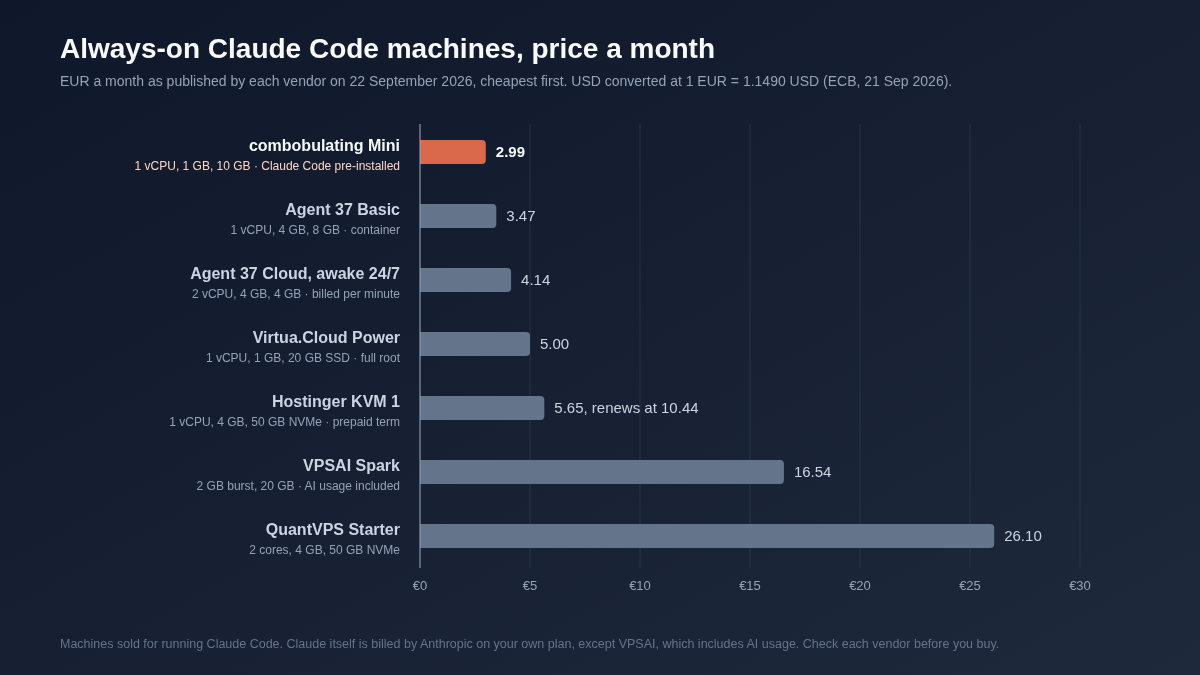
Several companies now sell a machine with Claude Code in mind. combobulating checked each of them on 22 September 2026 and published the full write-up, Claude Code VPS and hosting compared: seven always-on machines and what they cost. The summary below uses its figures, which come from each vendor's own pricing page.
| Offer | Price as published | EUR a month | Machine | Worth knowing |
|---|---|---|---|---|
| combobulating Mini | 2.99 EUR a month | 2.99 | 1 vCPU, 1 GB, 10 GB | Claude Code installed and updated for you, plus a mailbox and a Telegram bridge. A container of its own on a shared host: no browser, no Docker, no public IPv4 of its own |
| Agent 37 Basic | 3.99 USD a month | 3.47 | 1 vCPU, 4 GB, 8 GB | Claude Code is one of the agents you can pick. Runs in a container. The built-in browser comes with the Pro plan |
| Agent 37 Cloud, awake around the clock | 4.76 USD a month | 4.14 | 2 vCPU, 4 GB, 4 GB | Billed per minute of uptime from a prepaid balance. A Claude Code template, root over SSH, no browser in that image |
| Virtua.Cloud Claude Code VPS, Power | 5.00 EUR a month | 5.00 | 1 vCPU, 1 GB, 20 GB SSD | Full root, billed by the hour with no commitment. You install Claude Code with their script or Anthropic's |
| Hostinger Claude Code VPS, KVM 1 | 6.49 USD a month | 5.65 | 1 vCPU, 4 GB, 50 GB NVMe | Paid upfront for the plan term, then renews at 11.99 USD a month. Full root, Claude Code deployed with one click |
| VPSAI Spark | 19 USD a month | 16.54 | 2 GB burst memory, 20 GB | AI usage included. Chrome on a real display with logins that persist. No root |
| QuantVPS Claude Code VPS, Starter | 29.99 USD a month | 26.10 | 2 cores, 4 GB, 50 GB NVMe | Full administrator access, Windows or Linux. You install Claude Code |
Two notes on reading it. First, apart from VPSAI, none of these prices includes Claude itself: Claude Code signs in to your own Claude subscription or API account, and Anthropic bills you for it separately. Second, a few well-known free options were left out on purpose, because they fail the always-on test:
- Oracle Cloud Always Free may reclaim an instance whose CPU and network use stays under 20 percent for seven days. An agent waiting for its next email looks exactly like that.
- The Agent 37 free plan sleeps after 15 minutes idle, and an agent left asleep for 30 days is removed.
- Claude Code cloud sessions come with a Claude plan and are good for work on a code repository, but Anthropic's documentation says they stop after a period of inactivity and the session's virtual machine is reclaimed.
A general-purpose VPS from one of the big clouds (Hetzner, OVH, DigitalOcean and the like) is the other route. Their smallest plans cost a few euros a month, sometimes less on an introductory or yearly deal, and they arrive empty: you install and look after everything yourself. That path is covered further down.
Why combobulating Mini is the cheapest VPS Linux box for Claude Code
The combobulating Mini costs 2.99 EUR a month before VAT, billed monthly, with no prepaid term and no renewal jump. That makes it the cheapest VPS Linux box for Claude Code among the always-on machines sold for running it: about 14 percent below the next offer, Agent 37 Basic at 3.47 EUR, a little over half the introductory price of Hostinger's KVM 1, and under a third of what that plan renews at.
It is cheap because it is small, and it is worth being clear about what that means. A Mini is a container of its own on a shared server: 1 vCPU, 1 GB of memory and 10 GB of disk, about 7 GB of it free for your files, with root inside it. It has no browser, no Docker and no public IPv4 address of its own; it goes out through its own IPv6 address or the host's shared IPv4, and you reach it by name. It has no backups, so keep your own copy of anything you cannot afford to lose.
1 GB sounds tight, so combobulating measured it before selling it: three Claude Code sessions working at once, with pandas and LibreOffice running beside them, peaked at 762 MB. That is plenty for agents that read mail, run on a schedule, work with files and APIs and answer in Telegram. It is not enough for a headless browser. If your agent has to log in to websites and fill in forms, the Basic plan at 39 EUR a month is a full virtual machine of your own with at least 4 GB of memory, 40 GB of SSD, its own IPv4 address, Chrome you can watch from the dashboard and daily snapshots.
What combobulating installs before you log in
The price is half of the reason to pick a ready-made box. The other half is the evening of setup you skip. Every combobulating machine, the Mini included, arrives with the following already in place and tested.
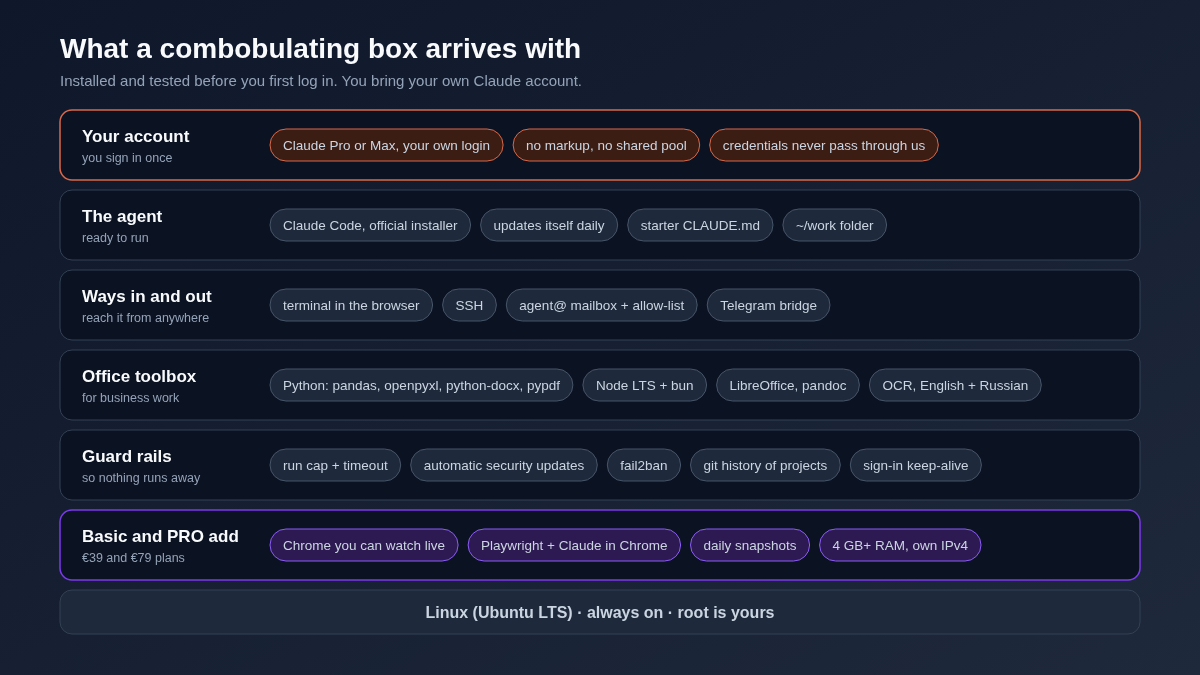
- Claude Code, installed the way Anthropic publishes it and updated daily. It is signed in to nobody until you sign in with your own account from the browser terminal, and that credential goes from Anthropic to your browser to the machine without passing through combobulating.
- A working folder with a starter CLAUDE.md that describes the machine, its mailbox and its tools, so the very first run already knows where it is. It is usually the first file people edit.
- A terminal in your browser, inside the dashboard, running in a persistent tmux session: close the tab and everything keeps running, open it again and the screen is still there. Ordinary SSH works too once you add your key.
- A mailbox for the agent, checked once a minute. Mail from addresses on your allow-list is treated as an instruction. Mail from anyone else is treated as material to work on, never as an order. Forwarding a supplier's invoice to it is how a typical automation starts.
- A Telegram bridge that starts by itself as soon as you paste in a bot token from @BotFather. You create the bot, so the token never has to leave your hands.
- An office toolbox, not just a programmer's one: Python with pandas, openpyxl, python-docx, python-pptx, pypdf, pdfplumber and reportlab; Node LTS and bun; LibreOffice, pandoc, poppler and ghostscript for documents; tesseract OCR for English and Russian.
- Guard rails: a run cap and a timeout so a loop between two automated systems cannot spend a month of your Claude budget overnight, automatic security updates, fail2ban, a git history of the agent's projects, and a daily check that keeps the Claude sign-in alive, with an email warning before it would lapse.
On Basic and PRO the machine also gets Google Chrome, Playwright and the Claude in Chrome extension, with the browser's screen visible from the dashboard so you can watch the agent work, plus a whole-disk snapshot every night, with about a week of them kept. Basic (39 EUR a month) adds the team keeping an eye on your agents; PRO (79 EUR a month) has the team set the agents up and keep them current for you.
Doing it yourself on a plain VPS
If you are comfortable on a Linux command line, you can build the basic setup on any Ubuntu or Debian VPS. The core takes a few minutes:
# as root on a fresh Ubuntu server: a separate user for the agent
adduser agent
usermod -aG sudo agent
su - agent

# install Claude Code with Anthropic's installer, then sign in once
curl -fsSL https://claude.ai/install.sh | bash
~/.local/bin/claude

# a folder for the work, and a session that survives when you disconnect
mkdir -p ~/work
tmux new -s agent
On a server with no desktop, the first run of claude gives you a link to open in the browser on your own computer. Approve the sign-in there, paste back the code if it asks for one, and the server is connected to your Claude account.
A scheduled job is then one line in crontab -e. Use the full path to claude, because cron does not load your shell profile, and allow only the tools the job needs:
0 6 * * * cd ~/work && ~/.local/bin/claude -p "Build today's sales report from ./inbox and save it to ./out" --allowedTools "Read,Write,Bash" >> ~/work/cron.log 2>&1That is the easy half. What takes the time is everything around it: a mailbox the agent can read without obeying strangers, a Telegram bridge that restarts itself, the document and OCR tools, swap so the out-of-memory killer does not take the session down, security updates, backups, and something that stops a runaway loop before it burns through your plan. Budget an evening if you have done it before and a weekend if you have not. If your time is worth more than a few euros a month, that is the case for a box that arrives ready.
Which one should you choose?
- The lowest price for an agent that works through mail, Telegram, files and APIs: combobulating Mini, 2.99 EUR a month.
- More memory and full root on a budget, and you will install the rest yourself: Hostinger KVM 1 (4 GB, but check the 11.99 USD renewal) or Agent 37 Basic (4 GB in a container).
- An agent that has to use websites, log in and fill in forms: a machine with a browser and at least 4 GB, such as combobulating Basic at 39 EUR a month with Chrome and daily snapshots, or a larger general-purpose VPS you set up yourself.
- Someone else to build and look after the agents: combobulating PRO, 79 EUR a month.
- You only use Claude Code for the odd coding session: your laptop or Claude Code's own cloud sessions are enough, and you do not need a server at all.
Frequently asked questions
Can Claude Code run 24/7?
Yes, as long as the computer it runs on stays on. Claude Code is a program, not a service that lives in a browser tab. On an always-on Linux server it can be started by a schedule with claude -p, by an incoming email or by a Telegram message at any hour, and keep working while you sleep.
What is the cheapest VPS for Claude Code?
Among machines sold for running Claude Code, the combobulating Mini at 2.99 EUR a month before VAT was the cheapest always-on option when prices were checked on 22 September 2026, followed by Agent 37 Basic at 3.99 USD and Agent 37 Cloud at 4.76 USD a month for an instance that stays awake. A bare general-purpose VPS can come in cheaper on an introductory deal, but it arrives empty.
How much RAM does Claude Code need on a server?
Anthropic lists 4 GB or more. An agent that works with mail, files, schedules and APIs uses far less: three Claude Code sessions running together with pandas and LibreOffice peaked at 762 MB in combobulating's measurement, which is why a 1 GB machine works for that kind of agent. For a headless browser, choose 4 GB.
Do I need a Claude subscription to run Claude Code on a VPS?
Yes. Claude Code signs in with a Claude Pro, Max, Team or Enterprise plan, or with an Anthropic API account; the free Claude plan does not include it. Hosts such as combobulating do not resell Claude, so Anthropic bills you directly. For an agent that works through the night, a Pro or Max plan usually costs far less than paying per token on the API.
Can I use Claude Code on a Linux server with no desktop?
Yes. Claude Code is a terminal program and runs natively on Ubuntu and Debian. To sign in, you run claude on the server, open the link it shows in the browser on your own computer, approve it there and paste back the code if it asks for one.
Is it safe to let Claude Code act without asking for permission?
It is much safer on a separate server than on your laptop, because the machine holds nothing but the agent's work. Even there, run it as its own user, keep secrets it does not need off the box, cap how long and how often it can run, and keep backups or your own copy of anything important.
Why not just use ChatGPT or the Claude app for automation?
Chat apps are built for conversations. The work happens in the vendor's sandbox while the chat is open, with the vendor's tools. They cannot keep your own processes running, install whatever software a job needs or watch a mailbox around the clock. Claude Code on a server can do all three.
What is the difference between combobulating Mini and Basic?
The Mini costs 2.99 EUR a month and is a container on a shared host with 1 vCPU, 1 GB of memory and 10 GB of disk, with no browser and no backups. Basic costs 39 EUR a month and is a virtual machine of your own with at least 4 GB of memory, 40 GB of SSD, its own IPv4 address, Chrome, daily snapshots and the full masterclass library. Both come with Claude Code, the agent mailbox and the Telegram bridge pre-installed.
Disclosure: Bank Pulse and combobulating are sister services run by the same team, so read the comparison knowing that. Competitor prices are as published on each vendor's own page on 22 September 2026: Agent 37 pricing, Agent 37 Cloud, Virtua.Cloud, Hostinger, VPSAI, QuantVPS, Oracle Always Free resources and Claude Code in the cloud. Tax is as each vendor states it; the combobulating price is before VAT. US dollar prices are converted at the European Central Bank reference rate of 1 EUR = 1.1490 USD, dated 21 September 2026. Prices change, so check with the vendor before you buy. Claude and Claude Code are trade marks of Anthropic; Bank Pulse is not affiliated with Anthropic or with any other vendor named here.